

AI Advisory Board by 973 Labs
Boards of directors are under increasing pressure to make faster, more rigorous decisions across an ever-broader set of domains — strategy, risk, regulation, talent, technology, geopolitics. Expanding human expertise is slow and expensive. Yet condensing complexity into short board packs creates blind spots.
This is where the idea of an "AI Advisory Board" built from a coordinated set of AI agents becomes compelling. Instead of replacing the board of directors, these AI agents function alongside it: continuously scanning relevant signals, testing assumptions, and offering decision support that complements human judgment. Think of it as extending the board's thinking capacity without extending the organisation's hiring costs.
One of the most powerful aspects of this concept is its ability to embed structured decision-making models directly into the advisory workflow. The Six Thinking Hats framework, for example, can be translated into distinct agent roles — each operating with a different lens: analytical rigour, creativity, risk evaluation, stakeholder empathy. Rather than generating a single, blended response, the tool produces a deliberately balanced set of perspectives, helping decision-makers see what they might otherwise miss.
The objective is not merely faster answers. Better questions. More complete reasoning. Clearer trade-offs.
Objectives
- Enhance informed decision-making by providing multi-perspective analysis and structured reasoning.
- Reduce advisory bottlenecks through rapid, always-available agent support.
- Strengthen governance quality by making assumptions, risks, and options more explicit.
- Enable cost-effective expertise without over-reliance on expensive incremental leadership hires.
- Complement human judgment, not replace it — supporting directors with clearer thinking, not automatic decisions.
The future of governance won't be defined solely by who sits at the table. It will be defined by how well leaders can think — and how effectively they can operationalise diverse perspectives when the stakes are high. An AI advisory board of coordinated agents offers a new path: disciplined, structured, and decisively practical.
Industry adoption and real-world precedents
Across leading institutions, elements of the "AI Advisory Board" concept are already beginning to emerge — even if they are not yet formally described in those terms. Large financial institutions such as Lloyds Banking Group have introduced AI-powered tools to support executive and board-level discussions. JPMorgan Chase, Goldman Sachs and Citigroup are deploying AI for risk modelling, strategic evaluation and rapid operational audits.
Beyond the financial sector, companies such as Unilever and Siemens use AI to simulate market dynamics, operational outcomes, and business scenarios — providing leadership teams with deeper insights to support decision-making. Collectively, these examples point to a significant shift in corporate governance: not discarding existing frameworks, but strengthening them with always-available sources of analysis, challenge and decision support.
| Organisation | Where it's already happening |
|---|---|
| JPMorgan Chase | COiN platform for rapid legal and operational audits |
| Lloyds Banking | AI tools for executive and board-level discussions |
| Goldman Sachs | Risk modelling and investment scenario analysis |
| Citigroup | AI for strategic evaluation across business lines |
| Unilever | Market simulation to support brand strategy |
| Siemens | Operational outcome modelling for leadership |
| EY · McKinsey | Research showing higher governance quality with AI |
| 973 Labs | Live AI Council for innovation governance |
The economics of board governance
Boards are increasingly expected to address complex issues, yet the traditional ways of expanding their expertise — hiring directors, retaining consultants — remain both slow and costly. An AI advisory board brings in an economic model that is radically different at the core. It is like investing in a system that can be deployed repeatedly for different decisions and contexts, rather than continuously hiring expensive human expertise each time.
AI can keep itself updated on regulatory changes, model strategic alternatives, and perform risk assessment without incurring incremental advisory fees. Gradually, this transforms governance from a fixed-cost structure to a more flexible pattern of sourcing expertise whenever it is needed. McKinsey & Co. research has found that companies heavily using AI can cut external advisory spend by 30–60% — especially in knowledge-intensive areas. Better and faster access to relevant information also reduces the often-invisible cost of delayed decisions.
Beyond cost — a step-change in decision quality
Traditional boards face cognitive constraints that significantly limit their effectiveness. Members work with condensed reports, operate under severe time pressure during meetings, and often rely on personal experience — which together can cause both qualitative and quantitative analysis to remain relatively shallow.
An AI advisory board fundamentally changes this dynamic. It continuously sifts through vast amounts of data, runs decisions through a range of modelled outcomes, and generates structured, real-time insights. Leadership can revisit and adjust decisions as new data emerges, and explore a broader set of strategic options without being constrained by the natural limits of human deliberation.
AI doesn't accelerate decisions at the expense of quality — it surfaces assumptions, makes trade-offs explicit, and lets boards stress-test conclusions before committing.
BBK Spark AI Council
The following section details the technical architecture and live implementation of the AI Advisory Board concept as built and deployed by 973 Labs.
System architecture overview
| Layer | Technology | Purpose |
|---|---|---|
| Frontend | Modern web stack | Real-time streaming UI |
| Backend API | Enterprise application framework | Council orchestration and prompt engineering |
| AI Engine | Self-hosted LLM infrastructure | On-premise inference across multiple model families |
| Database | Managed relational database | Session persistence and audit trail |
| Hosting | Private cloud with global delivery | Secure delivery and traffic management |
| Real-time | Event streaming protocol | Live streaming of responses |
Agent roles — the Six Thinking Hats
Each agent operates with a distinct cognitive lens and a temperature setting tuned to its purpose — lower for analytical roles, higher for creative ones. The Chairman synthesises all perspectives into a single recommendation.
White Hat
Red Hat
Black Hat
Yellow Hat
Green Hat
Blue Hat
Session flow — 51 LLM calls per question
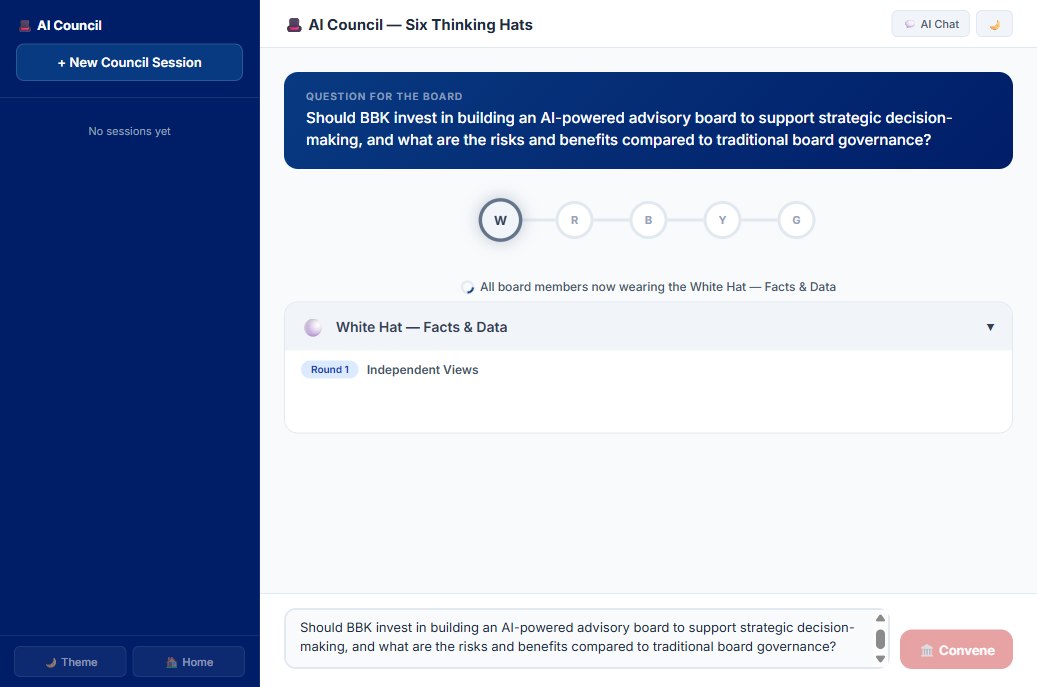
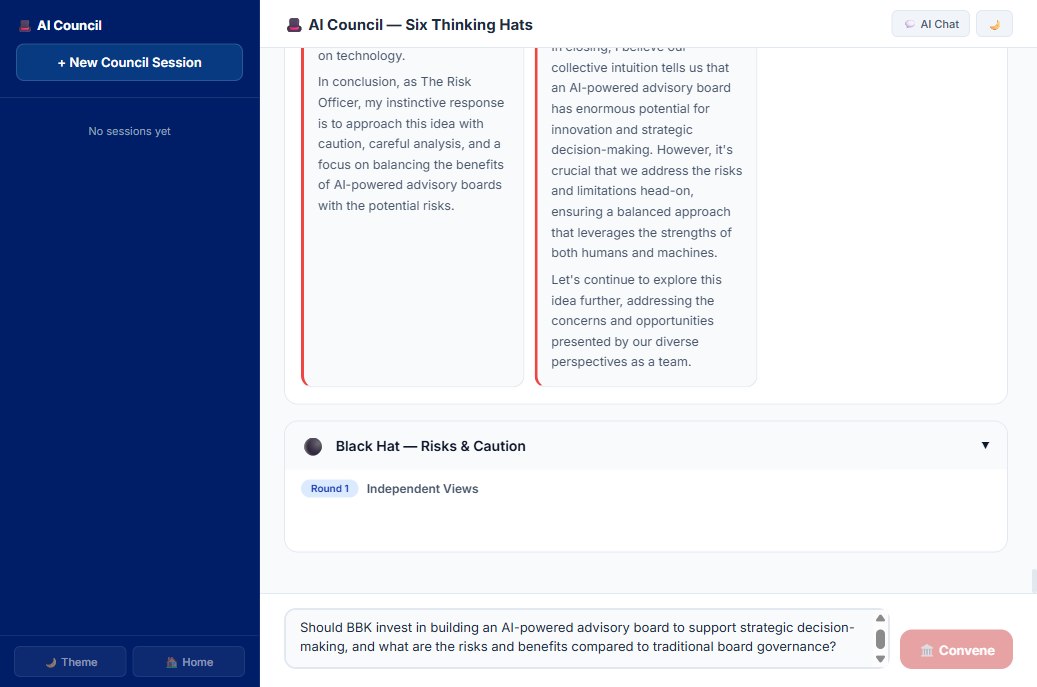
The architecture deliberately separates independent thinking from debate. Round 1 prevents groupthink by asking each member to respond in isolation. Round 2 introduces structured challenge — members see each other's Round 1 outputs and must agree, disagree or refine. The Chairman then produces the synthesis.
How a session unfolds
- Round 1 — Independent views. Each member responds in parallel; no member sees another's answer. (5 parallel LLM calls per hat.)
- Round 2 — Debate and challenge. Members receive all Round 1 responses and must engage — agreeing, disagreeing, refining. (5 parallel LLM calls per hat.)
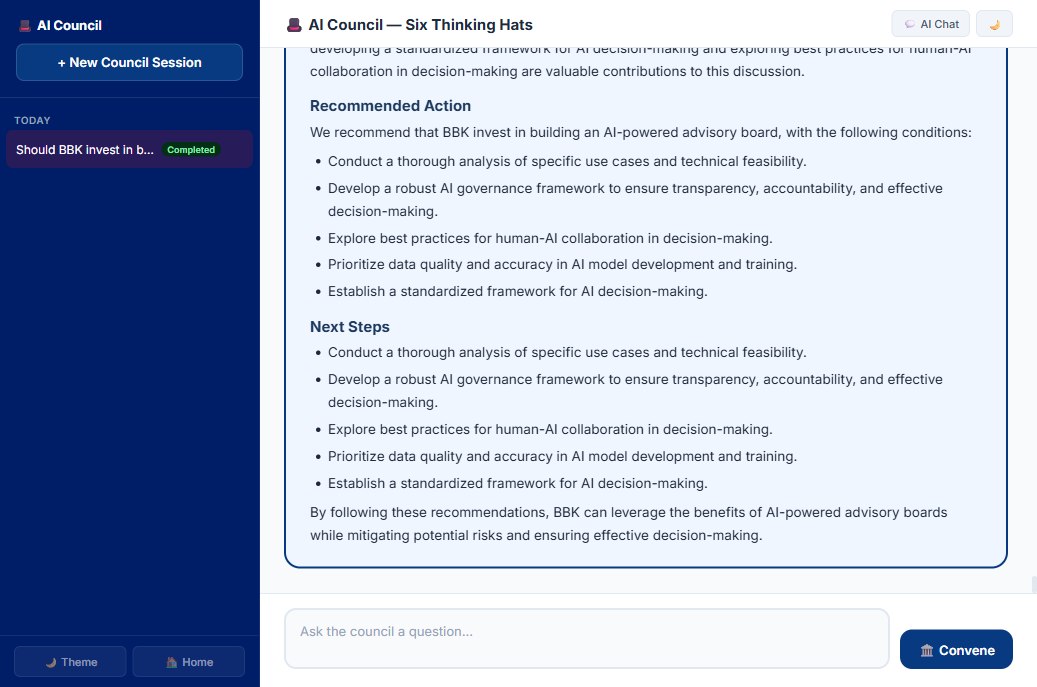
- Chairman synthesis. Produces a structured recommendation: Executive Summary, Key Insights, Risks, Recommended Action, Next Steps.
Key technical differentiators
| Feature | Detail |
|---|---|
| Parallel execution | Concurrent agent execution reduces session time by ~80% |
| Real-time streaming | Each response streams live as it's generated |
| Structured debate | Round 2 receives full Round 1 context |
| Temperature control | Calibrated creativity settings per role |
| Session persistence | Full audit trail retained for governance review |
| Self-hosted AI | No data leaves the organisation |
| Bank-grade security | Enterprise-grade encryption, authentication, rate limiting and audit controls |
Data sovereignty
Unlike cloud AI services, the AI Council uses self-hosted LLM infrastructure. No board discussions or strategic data leave the organisation's controlled environment, supporting internal governance standards and applicable regulatory data-residency requirements.
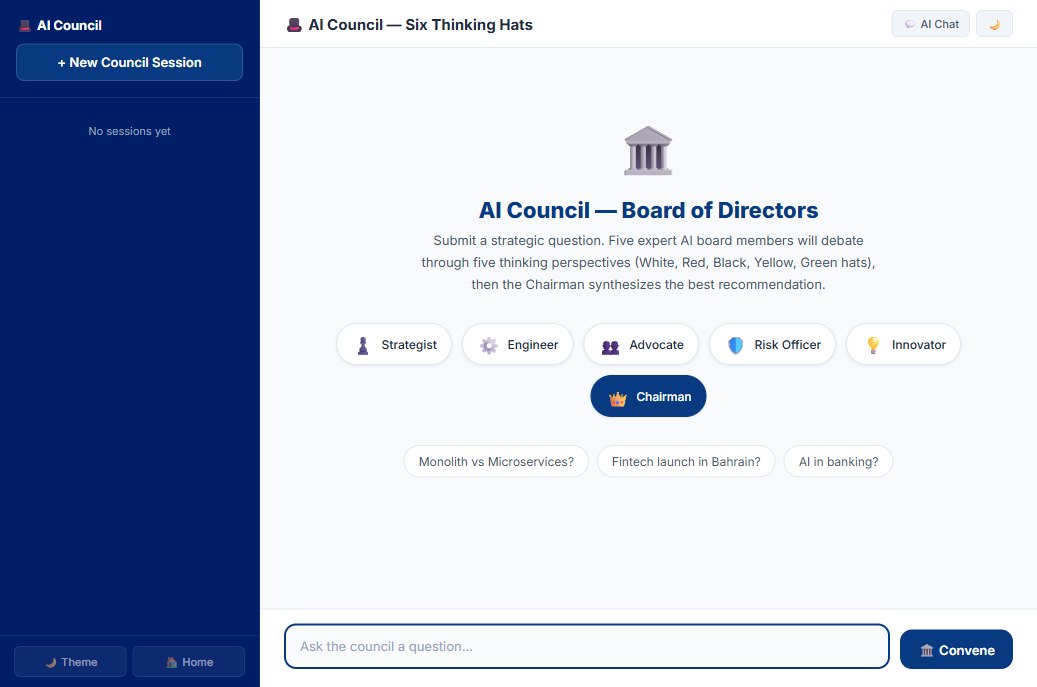
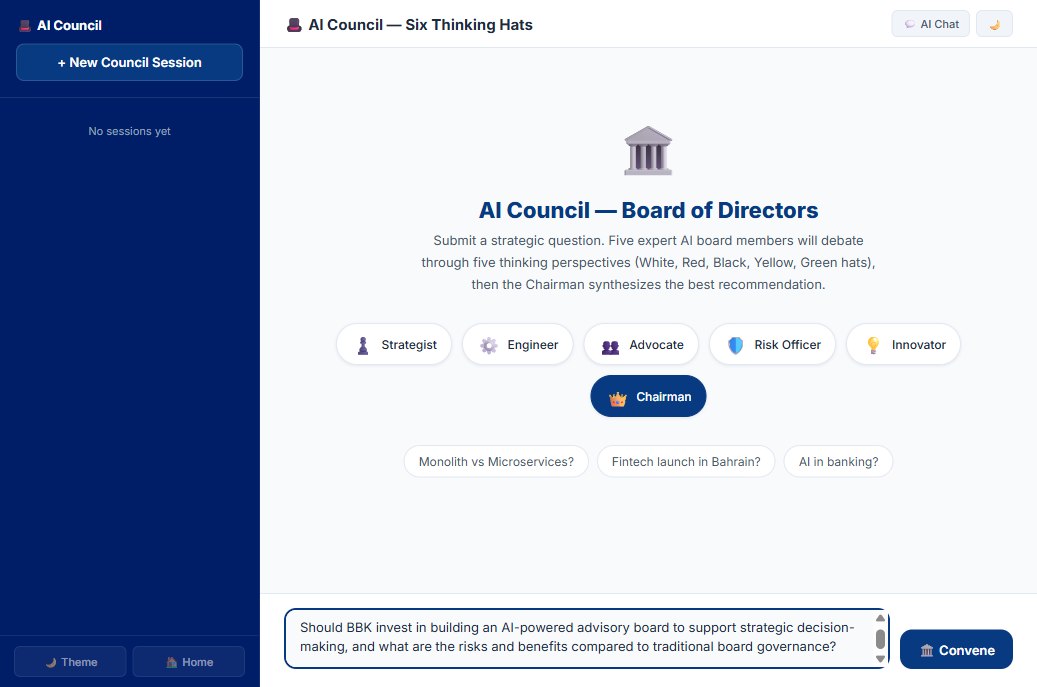
Live system — five stages of a session
The screenshots below walk through a single end-to-end session — from question submission to the Chairman's final recommendation.
Sources & further reading
- Citigroup (n.d.). Artificial intelligence at Citi. citigroup.com/global/insights/ai
- Deloitte (n.d.). Board governance. deloitte.com/global/risk/board-governance
- EY (n.d.). How boards can govern artificial intelligence. ey.com/board-matters/how-boards-can-govern-ai
- Goldman Sachs (n.d.). Artificial intelligence insights. goldmansachs.com/insights/artificial-intelligence
- Harvard Law School Forum on Corporate Governance (n.d.). corpgov.law.harvard.edu
- JPMorgan Chase (n.d.). Artificial intelligence. jpmorgan.com/insights/technology/artificial-intelligence
- Lloyds Banking Group (n.d.). Transforming our group: Data and AI. lloydsbankinggroup.com/insights/data-and-ai
- McKinsey & Company (n.d.). The state of AI. mckinsey.com/quantumblack/the-state-of-ai
- PwC (n.d.). Governance Insights Center. pwc.com/us/governance-insights-center
- Siemens (n.d.). Artificial intelligence. siemens.com/artificial-intelligence
- Spencer Stuart (n.d.). U.S. board index. spencerstuart.com/us-board-index
- Unilever (2023). How we use AI. unilever.com/news/2023/how-we-use-ai